Kaluapele

On the Island of Hawaiʻi, Kaluapele (the pit of pele or Pele) crowns the summit region of the volcano Kīlauea.

11 April 2020

Saturday, April 11, 2020. Loose ends tied up...

Ahhhh...


sun shining morning
light breeze lau olapa sway
still a bit chilly

What are you?  Me???  First thing that comes to mind:  a Naturalist.  Of course there are other things that I am, but Naturalist, I think, is at the fore.  Iʻve always been curious, and Iʻve spent a lot of time wandering and wondering outside.  Ma:  You kids:  Go outside play!
(and wash your feet before you come in the house!).  In the good old days, it was playing in the yard, going down to Grampa and Grammaʻs house, exploring all the trails and paths in their jam-packed kinda spooky garden, finding geckos and "Look Gramma..." knowing sheʻd scream hysterically while we ran away.  Going to The Gulch to check the steer, maybe taking it a ti leaf treat... 

Those of you who fashion lei lāʻī, those twisted or braided (two methods of "hilo") adornments, know that your hands get sticky.  Plant sugars.  TryTaste next time.  Pipi LOVE it...good way to make friends with them.  

All that outside time allowed many of us to hone our observational skills.  I believe that there are more naturalists than not out there.  Especially those of us of a certain age (i.e. olʻ futs), all of us pre-electronica gadgeteria, who found ways to productively occupy our time with little direction from elders after being shown how. Go play outside.  Go pull weeds, go pick [beans, Chinese peas, carrots, Mānoa lettuce, peanuts], go water (anʻ no get wet!), go pick oranges (or tangerines)... 

Howʻs THIS for a tangerine tree?  Hilo and environs seem to have an inordinate number of extremely fruitful (in a good year) tangerine trees.  Our version of mangoes on Oʻahu...


on the side of the road in Mountain View...one hopes that theyʻre juicy and sweet.  But that seems to depend on the year:  the weathers; the rain, the sun, the hot, the cold...  And keep the skin.  Dry em.  Save in the freezer.  Then put some in oxtail soup, jook, etc., for that "Hmmm whatʻs this taste?  Ono!

Um...Where were we???  Oh.  Naturalists...  All we were doing was Being Outside and Paying Attention.  No charge, No registration, all Free.

And so it is with my friend Lisa on Maui.  An amazing and humble woman.  Her mom and I became fast friends after meeting in Bea Kraussʻs ethnobotany class at UH Mānoa in ʻ71 or ʻ72 I think.  Bea was amazing.  She died at 94 in 1998.  When she taught us she had been "retired" for several years.  First day of class"  "Put away your pens and notebooks"...She wanted us to listen to her.  To hear her.  To pay attention without the distraction of note taking.  At the end of class sheʻd hand out a typed and mimeographed sheet (remember the purple ink?) of pertinent info for the plant-of-the-day.  Those sheets eventually became the basis for her book:


And hereʻs a clip of Bea from ʻuluʻulu  an extremely valuable archive of moving images:
Bea Krauss and ʻawa .

Memories...sometimes Iʻm asked:  How do you know all this stuff???  And I reply:  Iʻve had great teachers and mentors who each, in their own ways, sated my curiosities of the moment, and inspired others.

Sooooo... Lisa!  Back to Lisa.  Her curiosities are expansive like mine and her motherʻs.  But Lisaʻs are focused on kapa and waihoʻoluʻu.  Barkcloth and dyes.  Iʻve shared about maʻo hau hele, our endemic yellow hibiscus State Flower [March 28, 2020 blog].  And Lisa recently shared


a piece of her kapa dyed with maʻo hau hele (Hibiscus brackenridgei) flowers from Maui.  Note the dark centers.  Ours are pure yellow.  Pick up the wilted old flowers from the ground.  Put in pot with water, boil, add lilla bit (a teaspoon or so) wood ash from the fire, and let sit for a few hours.  When kapa or cotton fabric is thus colored, the dye will oxidize, changing color from greenish to bluish.  Waihoʻoluʻu ʻinikō (indigo dye) does the same thing.  GoTry.  Lisa and I were chatting about wood ash.  How did "They" figure that out?  In the era pre-metal-pots, stones were heated in fire, then picked up (wood tong sticks) and dropped into gourds or wood bowls to heat liquid held therein.  Ash clung to pōhaku, mixed with liquid, and voila!  Or something like that.

And please donʻt confuse maʻo hau hele with maʻo (Gossypium tomentosum), our endemic cotton.  Ours canʻt be used to make cotton fabric - the fibers are way too short - but it is used to make dye.  And maʻo apparently never grew naturally on the Island of Hawaiʻi, as it did/does on other islands, though now itʻs cultivated here, as below in South Kohala.


Below, a Lisa experiment Iʻm particularly excited about.  Growing on the lavalands of Kona ʻAkau is a small tree with THE most spectacular endemic flowers.  Ever.  The critically endangered (a small handful, if that, left in The Wild) Kokiʻo (Kokia drynarioides).  I first met this tree in the  late 70s while traipsing about the lavalands with HK and Tōb.  Well...more stumbling through dense chest-high fountaingrass growing on ʻaʻā, rather than traipsing...

Its pua are mindbogglingly beautiful.  The two photos immediately below are mine, the two that follow, Lisaʻs, from legally cultivated plants.


The next two show dye extraction processes.  Fascinating to me, because weʻve known that in the past, kokiʻo bark was harvested from trees in Kona ʻAkau so dye could be made to color and preserve fish nets.  We never dared experiment because of the rarity of the species.  A tree Lisa had purchased, planted, and was mature, recently broke, and so she was able to make dye.  


The process worked.  The much much more common kukui bark is also used to dye nets, and dye made from it and from kokiʻo have very similar colors.  If you try with kukui, be careful!  Only gather a little bit bark from each tree, ONLY by making parallel longitudinal cuts (up and down) to allow you to pry the bark off, after making sure that one one else did the same thing recently.  Wounds take time to heal.  NEVER cut a circle around the trunk.  Doing so severs vascular bundles, the nutrient transport system for the tree, thus girdling and killing it.  NOT a good conservation practice.

Last time, I think I told you about tiare, Tahitian gardenia (Gardenia taitensis), and their lovely scent, and then nānū, our endemic relative of tiare.  Tiare, in my experience, rarely set seed.  Maybe junk genetics, maybe flowers are not sexually complete, maybe pollinators are lacking... but seed pods do develop.  They are slightly elongate and ribbed.  And you simmer them to make dye.

More from Lisa.  First, tiare...


Nānū, on the other hand, has spherical unribbed pods.  And as said previously, stubbier flowers with the scent of "regular" gardenias:  David Eickhoff on Flickr:


Waihoʻoluʻu made from both tiare and nānū pods yield a bright yellow.  Below is nānū, again on kapa.  Note that the color is yellower than that of Polynesian introduction ʻōlena (turmeric or Curcuma domestica, a cultivated ginger).  ʻŌlena produces a dye with golden overtones.


So.  Go outside, be niele, and experiment.  Iʻm headed out for a stroll in the sun.  And while youʻre out and about, observing the Six Feet Apart rule, pay attention.  And TryWrite haiku about what you see, feel, taste, hear, and/or touch.  Lines of 5/7/5 syllables.  GoodFun.  Send em to me...no shame...

As always, with aloha,

BobbyC
maniniowali@gmail.com


09 April 2020

Thursday, April 9, 2020. WOW Weather!!!

All the birdies are having a rollicking great time, especially our ʻapapane.  They seem to trill at the sight of increasing lehua bloom, chatting to each other in treetops.  How lucky for us who get to live in native rainforest.  And yes, this is one of less than a handful of days this year where skies are clear and blue, morning sun warms the hale, and a hoodie is not needed.  No wonder the excitement.  Iʻm trying to type fast so I can go walk.  Just a short one along a street at the golf course.  Despite enthusiasms, too much too soon has proven detrimental to nūnī healing, with increased inflammation of the knee attachment of my IT band.  No...not a tech group playing instruments, rather the Ilio-Tibial band of muscle along the outer thigh, connecting hip and knee... So when Being Outside Paying Attention, now itʻs being attentive to knee position, gait, flex, and what-la...

Attentiveness and a great deal of patience...

We havenʻt forgotten Pelehonuamea and her works.  Mokuʻāweoweo and Kaluapele, those clearly demarked spaces atop Maunaloa and Kīlauea respectively, are stunningly clear this morning.


This HVO Maunaloa cam is on the northwestish rim of Mokuʻāweoweo.  That little gap on the right horizon leads to South Pit and the upper reaches of the SW Rift Zone of Maunaloa.  A screenshot of a topo map might allow easier visualization for some... the particular webcam is near the benchmark on the NW (left) side of the caldera.  Some may find it interesting that traditional ahupuaʻa and district (ʻāpana or ʻokana) boundaries converge at Mokuʻāweoweo.  Note that KAOHE ahupuaʻa, in Hāmākua, was mentioned in an earlier post.  It is unique in that it includes both the piko (summits) of Maunakea and Maunaloa.  Kaʻohe (the bamboo) starts as a very narrow strip on the Hāmākua coast just Hilo-side of Paʻauilo, ascends and widens to embrace Kūkahauʻula, the complex of summit cones at the summit of Maunakea, then sweeps down to the Saddle, and up the flank of Maunaloa to its summit.  A wonder of political geography.


Notwithstanding morning glare, we only see clouds on the horizon far out at sea, east of Kaluapele.


The brown metal roof of the tower at HVO (the Hawaiian Volcano Observatory) in the foreground, with a bit of māhu (steam) rising from cracks, wafted by kona winds.  
And from the same tower, a better-lit view of Maunaloa, to the west.  Those slopes seem insignificant, but the top of the horizon lies at 12,000+ feet elevation.


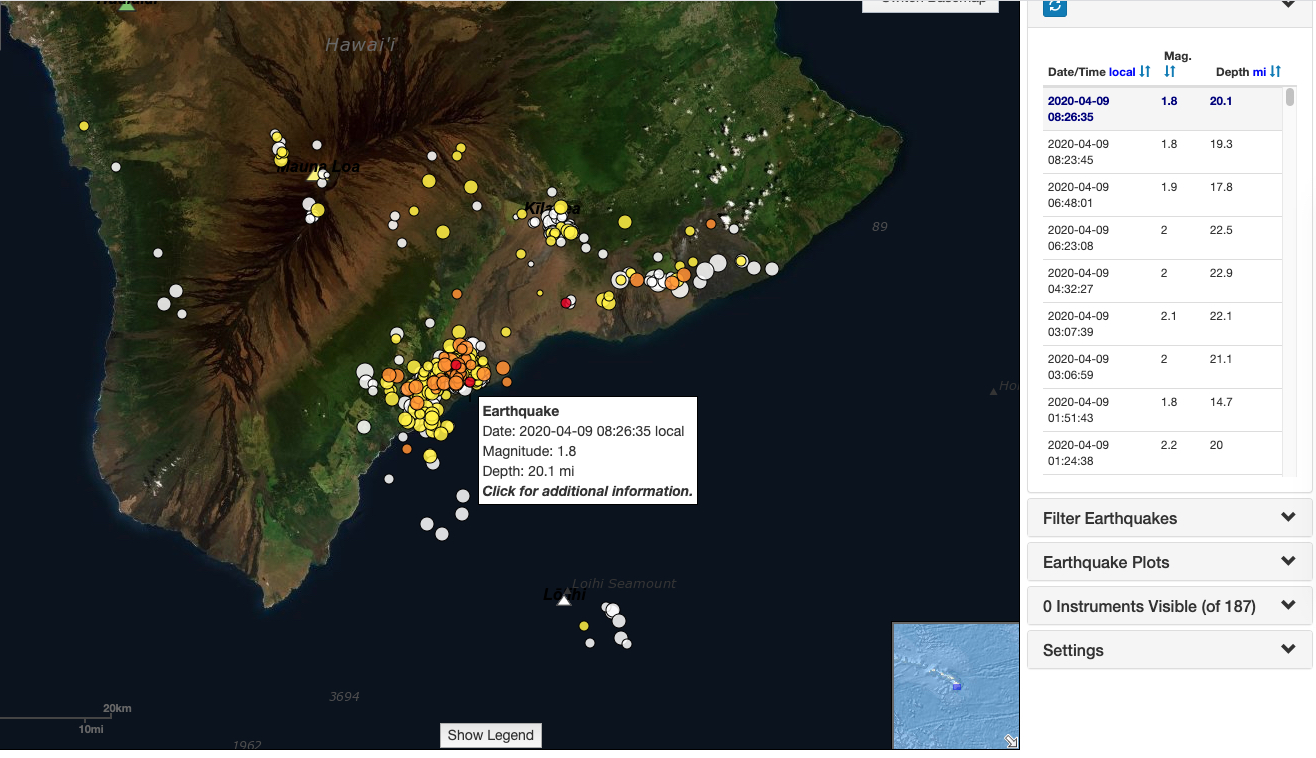
And in the news the last couple days, we heard of numerous ʻōlaʻi, that cluster of earthquakes near Pāhala, 25 to 30 miles from here:


Note that theyʻre all deep, in the 20+ mile range.  That activity has been ongoing for a few years, and is apparently indicative of deep processes related to magma movement.  No imminent eruption...

As we anticipate the two-year commemoration of the start of The Three Months of 2018, I suppose itʻs comforting that Pelehonuamea rests easy for the moment.

OK gang, Iʻm outta here.  A bit of exercise in the hale, then a short stroll, then knee icing...

Be well!  And if you find The News upsetting, No Watch.  Go Walk.  Check out Neal Milnerʻs piece on todays Civil Beat:

Overcoming the Walking Blues :  Be Outside.  Pay Attention.  Noho i waho.  A Maliu.

As always, with aloha,

BobbyC
maniniowali@gmail.com


04 April 2020

Saturday, April 4, 2020 Self-Reliance

I seem to do my best thinking when I become conscious in the morning.  Still abed, eyes closed, but aware of sounds, and whether or not the sky has lightened.  That still state, when thoughts, seemingly random, pop up.  This morning it was Self-Reliance.  

Iʻve been talking with friends about how these times are remarkably like the "Good Old Days".  Much less traffic, no tourists to speak of, infrequent but big quantity food shopping and planning ahead, and sort of an undefined quietness to the pace of life.  Yes, Iʻm single, so that last is likely not-so-much for those with energetic young people under roof.  I can imagine.  But nevertheless, it feels as it did decades ago.  Iʻll be 69 in a couple months, and like many, came to see The Government as Provider.  They provide many services, and we have expectations.  Clean parks and restrooms, efficient and helpful and honest public servants, laws to provide for a civil society, etc.  But.  I think without realizing it, weʻve become, as a society, dependent on any number of government programs.  Theyʻll do it.  Not my job.  

And now, with the luxury of time at home, we think and talk, and muse, and remember.  When we were so much more Self-Reliant.

Those of a certain age, who lived here in the 1950s remember, in 1958, a strike by sugar plantation workers.  It started on February 1, and ended June 6, 1958.  128 days.  It affected 13,700 workers on 26 plantations.  Four months.  No income.  Families to raise, bills to pay.  Kinda like now.  Kinda.  

The aerial photos below are found on the MAGIS website at UH Mānoa.  Maps, Aerial photos and GIS (geographic information systems).  They were taken on September 28, 1954.  Top one is of Honokaʻa and Haina.  Honokaʻa stretches parallel to the coast, though the east part is obscured by thin clouds.  Haina is ma kai of Honokaʻa, straight down The Hill.  That little plume at the shore is dirty sugar cane washwater from the Haina Mill.


Below we can see Paʻauhau at the center of the shore, with a much bigger plume, east of Haina.

Common to both photos are softly textured fields of cane.  Sugar cane was planted, starting in the mid-1800s, and became a major industry.  Major.  Land from the Wailuku River in Hilo to the edge of Waipiʻo valley, from the cliffed shore up to about 2,000 feet elevation, all of it, was planted in cane.


Cane was our life.  And so when The Strike happened, it was economically devastating.  But then, as now, we were all in it together.  For four months.  One of my momʻs cousins was a rancher,  and he and his wife, an excellent cook, set up one of those big green canvas Army tents in their yard.  Women and kids would spend much of the day there prepping and cooking meals.  Men would work in a community garden and harvest crops, hunt, slaughter cattle and pigs, go Waipiʻo to help plant and harvest kalo, etc.  All participated.  I remember flypaper strips hanging from the tent ceiling, and everyone talking story as they worked.  And too, we maintained our garden at home.

We made it through the strike.  Of course we did. We were self-reliant.  We, The Community, all knew each other; cared for and helped each other.  And Iʻm getting that same feeling now.  Even though we stay home, there are fewer distractions, and lives seem simpler.  Homeschool the kids, play with them, cook and eat what you have.  As a society, we seem to have fallen off the rails.  Everybody is busy working to make money to pay for $1,000 cell phones and not inexpensive data plans; big houses with master baths, fancy kitchens with granite counter tops, the latest appliances and gadgetry, electric vehicles (hmmm Where does lithium for those batteries come from?), giant flat screen TVs, fashionable fashions, restaurant meals, takeout foods, and donʻt forget the Daily Starbucks...  How did this happen?  

Yes, those are sweeping generalizations, and yes, there are those of us who try hard to live simply.  We arenʻt without fault, but living simply these days requires conscious will and effort.  No thanks.  No, thank you.  No need the big TV, the newest car, the latest As-Seen-On-TV gadget.  No Need.

We need family and friends, we need loyalty and kindness, we need to know that we arenʻt alone in all this.  And we arenʻt...  Nature and The Universe loves pitching curve balls.  Testing us.  Can?  No Can?  Before The Strike, the curve ball was, in my world, Polio.

The Salk polio vaccine was released April 12, 1955.  I got sick May 1, 1955 in Honokaʻa.  Spent a total of four months in hospital, and at rehab, in Honokaʻa, Hilo, and Honolulu.  Much of the time without family.  Imagine how devastated they were...


But maybe because I was so young, I donʻt remember much.  Being wrapped in hot,  steamed green itchy wool Army blankets to loosen my contracting muscles, a big stainless steel whirlpool bath to do the same thing, I think.  The orange-painted big-windowed Physical Therapy room at the Kauikeolani Childrenʻs Hospital in Honolulu with model airplanes hanging from the ceiling.  And then, after I came home, weekly drives to PT at the March of Dimes in Hilo.  The building still stands.  Ma driving the 1954 Chevrolet down the winding coast road through Hāmākua and Hilo, popping the horn at the sharp curves in the gulches to alert other drivers.  And negotiating for safe passage with laden cane trucks while avoiding rocks and cane stalks that the hāpai kō workers hadnʻt gotten to.  And we made it.

And if I was good during my physical therapy sessions, sometimes we went to the lunch counter at Kress for a burger boat.  Red plastic open weave oval bowls, lined with parchment, holding a burger and fries.  Or...Better yet:  Cream Horns at Robertʻs Bakery!!!

THE BEST!!!  Cold, coated with powdered sugar, flaky pastry, and soft, not-too-sweet pastry cream.  Like this:


 Oh.  My.  GOODNESS!!!  Below is an interior shot of Robertʻs Bakery, with owner Robert Taira, back in the day.  For some reason, I remember that the cream horns were in the refrigerated case to the right, just off the frame.


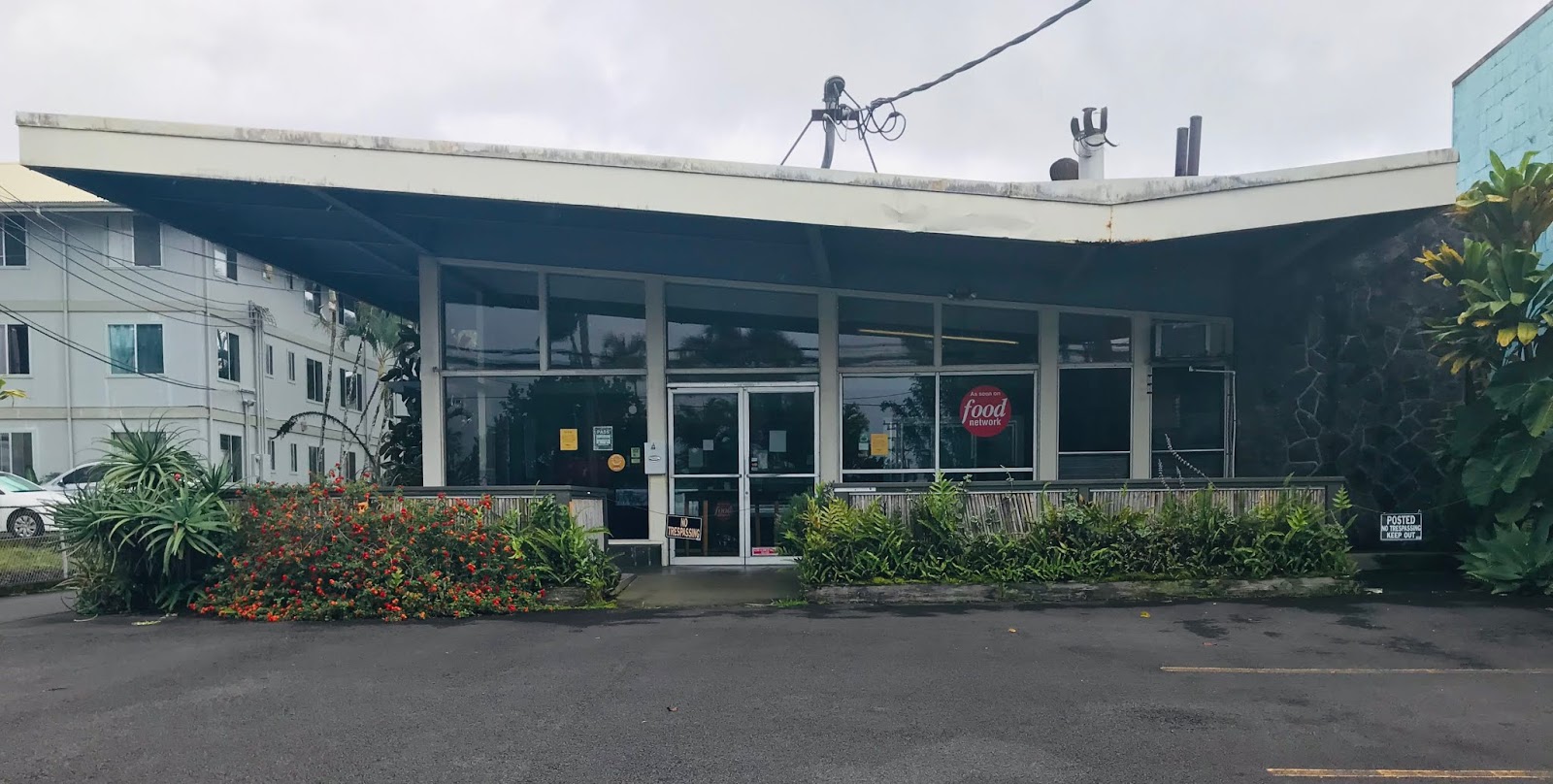
Robertʻs Bakery is now Short and Sweet, still on Kinoʻole Street, ma uka side between Jimmyʻs and the tennis courts.  Classic...


And then, Mr Taira, after Hilo success, opened other bakeries.  Read about Mr Taira.

Besides my cream horns, in Hilo, Mr Taira baked Portuguese Sweet Bread.  He fiddled with a recipe, and made his own style.  We never bought the bread, because Gramma Camara made and shared her own.  With raisins.  Because thatʻs what Daddy liked.

But Mr Tairaʻs bread was popular.  Very popular.  Today, people around the country know his Portuguese Sweet Bread as


now headquartered on Torrance, California.  

Ono bread, but Portuguese.  Not "Hawaiian".

Thanks for sticking with the ramble today.  Since weʻre on foods, and our versions of Portuguese foods, hows about a pot of Portuguese bean soup?  Having fun one day, I wrote this.  Translation available by request...


A couple notes:  for the spice mix, I find it easiest to put a tablespoon of each in a small jar and shake.  Then add the blend as needed.  Potagee cabbage (Portuguese cabbage) is a kind of kale.  Not easy to find.  TryAsk old people with gardens if they get.  It looks like this (thanks RK):


It keeps growing and growing.  Just break a branch and stick in the dirt.

OK then... Headed outside for some sun!

Stay well!  As always, with aloha,

BobbyC
maniniowali@gmail.com


03 April 2020

Friday, April 3, 2020... Those pesky ads

Wow wow wow... Iʻm sitting up here in the loft.  Itʻs HOT.  And yesterday in Hilo was hot too.  Blue skies, puffs of cumulus...light winds, mostly from the south, it seems.  Finally!!! After unending weeks of bonechill, sleeping under quilted layers, it feels so so so good to be warm without layers.  Yes, I know that this is likely temporary, but nevertheless...

These, from the HVO webcams, were yesterday morning


and these, also from an HVO webcam, at Mokuʻāweoweo, the summit caldera of Maunaloa, on March 18, then on March 24:


At the changing of the seasons...

Now...Those familiar with these fair isles, if attentive to detail, may tsk-tsk at "Errors" in advertisements with Hawaiʻi themes.  Methinks those are maybe not Errors, at least in the minds of the writers of said ads.  Rather, the misfires are the results of ignorance on the part of advertisers.  Laziness, ignorance, and of course:  "But I found it on The Internet"...It Must Be True!!!

Not...

Tiare, the Tahitian gardenia, is up there on The Favorites list.  It has a unique scent, and I adore it.  There are many hybrids out there these days, seemingly between tiare, and our endemic nānū [nāʻū to some].

Below is the true tiare:


 A bud... they open in early afternoon, if youʻre inclined to gather them and fashion


perhaps a kūpeʻe for your hair, as friend M-JW did several years ago, adding lauaʻe, a leafy fern, and moa, those knobby branchlets, for effect.


Here is our rare nānū, with its smaller flowers and leaves, and spherical dye-yielding seed pod.  Nānū seems to set seed easily, but Iʻve never seen a pod on a tiare shrub.


Hybrids look similar, though most have the typical gardenia scent, as does, to my nose, nānū.  Leaves of hybrids are often large and wavy, while tiare leaves are big and flat.

OK?  Now go TryLook The Internet.  The first from a Glade air freshener campaign.  Featuring a pink plumeria.


And this, with the classic Graveyard yellow plumeria, from oversoyed.com

The GYP is called that by some because itʻs frequently planted (or used to be...) in cemeteries.


And please note, dear readers, that "Monoi" is not a flower.  Rather, itʻs a tiare-scented coconut oil from Tahiti.  Following photo on Amazon:


And thatʻs just tiare...  Moving right along to other annoyances:


Kitty Litter?!  Really???


Iʻll just leave it at that.  

Tomorrow weʻll delve into the very popular Kingʻs Hawaiian brandings...

If nothing else, if itʻs sunny and warm, go sit outside.  And pay attention.  We all need Vitamin D...

Up here The Blooming has begun.  Itʻs lehua season again, and the ʻapapane are overjoyed.  Iʻve been admiring a blooming ʻōhiʻa across the street while lounging on the couch.  I was season-lost then remembered we were in March last month.  Just about the time of bountiful lehua last year.  Itʻs been that long.

As always, with aloha,

BobbyC
maniniowali@gmail.com


31 March 2020

Tuesday, March 31, 2020. Then, on March 31, 1987...

Can it be???  Thirty three years ago this evening???


This photo, by JD Griggs, then working as a photographer at the Hawaiian Volcano Observatory, brings back a flood of memories.  Iʻm the person in the yellow shirt, just to the left of pele.  I had a VHS video camera on my shoulder, and was recording the scene for Hawaiʻi Volcanoes National Park.  It was early evening, March 31, 1987, thirty three years ago.  

Mr Henry Kekahuna mapped the area in great detail.  Many of his exquisite maps are housed at Bishop Museum:

Kekahuna map of Punaluʻu, June 21, 1951


The heiau at Punaluʻu is shown at the left.  The pond is at the upper middle.  Pele entered from the left (east) and departed to the right (west).  Punaluʻu, in many circles, was called Queenʻs Bath, and the photo shows steam rising off the surface of the pool.

I was procrastinating (!!!) this afternoon, trying to bring order to random thoughts and ideas, and this rose to the surface.  Iʻll likely write more about that evening in the future...

This evening here, near ma uka-most Keaʻau, a chill paka ua falls, that rain with fat plopping drops signifying that snow is falling further ma uka.  Time for a pot of pork tofu with kai choy (mustard cabbage) and hot rice.

As always, with aloha,

BobbyC
maniniowali@gmail.com

28 March 2020

Saturday, March 28, 2020. More hibiscuses (hibisci?)

Ahhh... Attempting to settle into a schedule of sorts.  No need to wake at 3a to write because the house shaketh too much.  The need for exercise, and the accompanying loading of feel-good endorphins must be programmed too.  Wait too long the rains often come.  As they have for seemingly countless days.  Yay for those in the kaha lands of Kona ʻAkau where rains have consistently fallen since vog departed.  Forests, shrublands, and yards burgeon with greenery I hear tell.  Havenʻt been to that side of Hawaiʻi nei since...last Fall???

In mid-December I had a nūnī (new knee) installed by the extremely competent and able Dr Harpstrite, operating at Queenʻs.  Then I was off to the Rehabilitation Hospital of the Pacific on Kuakini Street, near the mouth of the valley of Nuʻuanu.  Spent 12 days there, learning how to walk adequately, climb (and descend) stairs, bathe, etc., before coming home.  I live solo in a home with stairs, so practice was needed so I could live more or less independently.  Dear family and friends brought groceries and drove me to physical therapy sessions in Hilo.  Appreciations and gratitudes abound.

Mid-January to mid-February the bending of nūnī did not improve. It wouldnʻt go past 80 degrees, despite exercises and exhortations.  Turns out I have a LOT of scar tissue in there, and nūnī needed to undergo an MUA (Manipulation Under Anesthesia).  Bending by Dr Harpstrite while I was asleep.  He says it sounded like so much Rice Krispies and some gravel as scar tissue tore.  You can imagine.  Now, on a good day, I "holo i mua me ka MUA" [go forward with (because of) the MUA], and nūnī can bend to 120 degrees, with lots of clicking and other odd sounds.  Seems to be working well, as it should, for the close to $55K price tag.  So, so, very happy I listened to Ma, and retired with medical insurance...rather than quitting in a fit of pique... Iʻve had to pay 1% of the bill...

In short, thatʻs what Iʻve been up to...

So.  Back to those hibiscuses...  Iʻm a sucker for color, and really appreciate the multiplicity of shades of hybrid flowers.  Some, of course, are more favored than others, but the fact and possibilities of helping create new versions can bewilder.

We have endemic (only found naturally in Hawaiʻi) hibiscuses.  A specific one, maʻo hau hele (Hibiscus brackenridgei), is our State flower.  The photo below is by weedmandan, found on Flickr.


Note the stubby curved pistil.  Petals are delicate and fragile, and leaves beautifully lobed.  Maʻo hau hele is one of our brightest endemic blooms, and very useful in making dye for kapa.  According to Jill Coryell, who I mentioned yesterday, maʻo hau hele is genetically different than other hibiscuses, and so isnʻt used (by her) for hybridization.  Iʻll follow up and report back about this issue.

Some Basic Botany from Sciencestein Secondary School Science:  


Now might be a good time to go outside, pick a hibiscus if one is available, and pay attention...  Hibiscus is a bit unusual, because the pistil and the stamens grow in one fused structure.  As we saw in pua lehua last fall, the stamens and pistils are separate.


Try to be concise, Robert... As above... Anthers carry pollen.  In little sacks.  The anther, when mature, pops open, allowing pollen grains to land on sticky stigmas.  A pollen tube grows down the style, eventually reaching the ovary, where eggs are fertilized by the pollen. 

In hibiscuses, anthers open a few hours after the flower blooms, allowing the hybridizer a window of opportunity to manually cross-pollinate two different flowers, rather than letting nature take its course and letting pollination happen naturally.  Sure hope this makes sense...

Not to confuse you, but below is a cross-section of a lily.  Same parts, different arrangement.


Now.  Below is the pistil of a hibiscus from FierySunset on DeviantArt. Note that the top-most anthers have popped open, with pollen grains visible.


And another found on Flickr by RayinManila, where all the anthers are open:


But the coolest, I think, is below:  an individual anther with spiky pollen grains.


Meanwhile, at Jillʻs in Mokulēʻia... I neglected to get names for most of her hybrids... but below is the bright yellow pollen donor:


Mating completed, below you can, I hope, see yellow pollen grains stuck to the sticky orange stigma of the purple flower.


Then...wait several months for seeds to develop and ripen, plant them, and if youʻre lucky, in a year and a half, flowers will bloom.  Jill says she deems maybe 3% of plants from each cross worthy of propagating.  

Some pretties follow...


and this last is, according to Jill, "Hae Hawaiʻi", the Hawaiian flag hibiscus.  Her version is that this flower originated in Australia, and was brought to Hawaiʻi in the late 1800ʻs.  It was cultivated as part of annexation protests, much like Hae Hawaiʻi quilts were sewn during that time.


Ending with an impromptu assembly, starring Halemaʻumaʻu Beauty:


I trust that this has been a worthwhile diversion, if only for the brilliant colors.  Comments, as always, are welcome...

And yes, especially now, 

be outside...pay attention     noho i waho...a maliu

As always, with aloha,

BobbyC
maniniowali@gmail.com
26 March 2020

March 26, 2020: Shall we???

Well, well, well...in the words of Paul McCartney in 1968:


Ob-La-Di, Ob-La-Da, life goes on, brah...

And indeed it does, on this Prince Jonah Kūhiō Kalanianaʻole Piʻikoi Day.  

Kūhiō Day

Many of you know that I started these scribblings nearly two years ago, very shortly after our last eruptive activities began on April 30, 2018.  I was miffed at the inaccurate news coverage, and as a venting mechanism (yes, pun intended), I decided to write rather than grumble.  Iʻve kinda intended to start writing again, but being an excellent procrastinator, kept putting it off.  Till today.  

Iʻve reached my news intake limit, and canʻt veg out and watch more of Family Feud, cooking shows, The Chrisleys and other mindless what-la.  So.  Having kept a notebook for the past couple years, Iʻve decided to dig through my accumulation of wonderings and attempt to put them in some order.  

I am not intending to write anything about CoViD-19 (Corona Virus Disease 2019).  Keyword:  "intending".  I imagine many are overwhelmed, or nearly so, with the multiplicity of news streams and feeds, and pray that all are paying attention to and obeying advices from reliable medical professionals such as our Lieutenant Governor Dr Josh Green, and Dr Anthony Fauci.  I am ever-grateful for my little house in the now-sodden woods, away from the cacophonies of our daily concerns and obsessions.  The pantry and freezer nearly overflow, the pahu wai (water tank) has overflowed nearly constantly all year thus far, propane was filled to 50% on Tuesday (small-kine rationing by HawaiiGas "in-case"), and Iʻm comfortable and fairly happy.

If any of you have a Topic of Interest I might have info about, let me know by sending an email to maniniowali@gmail.com  Happy to research and report, especially about natural and cultural histories.  Iʻm hoping to write a few times a week, and expect to find the discipline to do that.  Feel free to share this with family, friends, and acquaintances.

OK?

Backstory next time, but in February, with Papa and Chris, I found myself in Mokulēʻia on Oʻahu, visiting the delightful Jill Coryell, the Hibiscus Lady, and hybridizer extraordinaire.  More info on her and her works later, but I wanted to share a pic I took of one of Jillʻs selections, "Halemaʻumaʻu Beauty".  Those who have been fortunate to be with flowing pele will easily recognize the colors.  Spectacular!


Till then, be well.  As always, with aloha,

BobbyC
maniniowali@gmail.com